

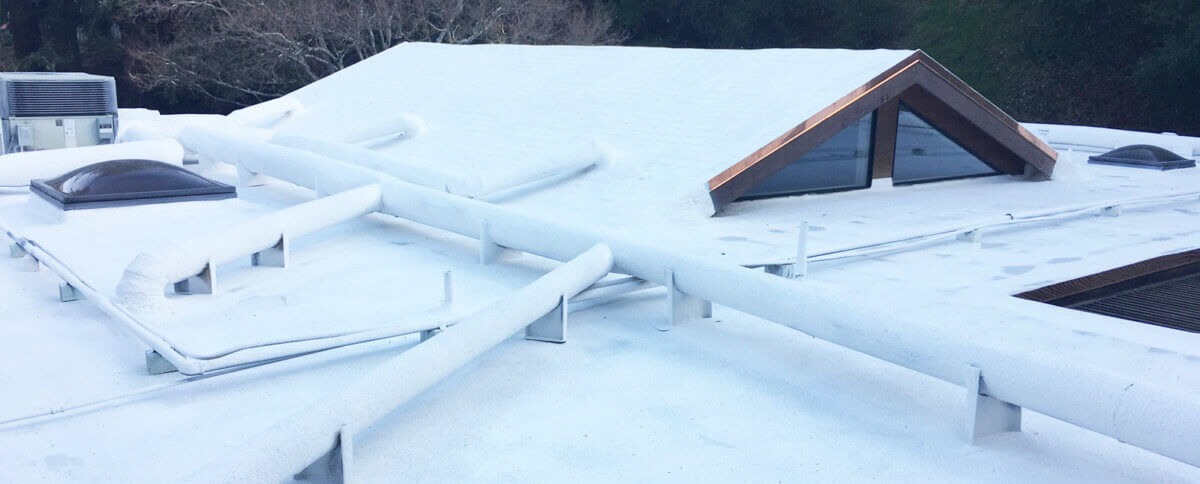
Have you ever looked up at a building with an awesome, weird or complex roof – maybe a giant dome, a roof that steps down in layers, or an old factory with tons of pipes and vents – and wondered how on earth they make sure that thing doesn’t leak? If you own a residential gem, a sprawling industrial facility, or a multi-story commercial building in the San Francisco Bay Area that features a unique or complicated roof design, you probably worry about this exact issue every time it rains.
Owners of complex properties often face serious concerns: traditional roofing materials, like heavy built-up roofing (BUR) or tar and gravel, struggle to conform to irregular surfaces, leading to seams that split, flashing that fails, and chronic water damage. Plus, old materials are often heavy, placing unnecessary structural stress on older buildings. The constant worry is finding a system that provides superior protection and insulation without forcing you to tear off your entire roof or compromising the unique structure of your property.
The good news is that there is a proven solution that handles curves, corners, peaks, and penetrations better than anything else: Spray Polyurethane Foam (SPF), often called foam roofing. Because SPF is applied as a liquid and cures into a rigid solid, it offers incredible versatility and is specifically noted as ideal for unusual roof shapes or designs. Armstrong Foam Roofing has been perfecting the SPF process for over 40 years, protecting some of the Bay Area’s most unique properties with a seamless, durable, and highly efficient system.
The Biggest Headache: Why Complex Roofs Fail
Residential, commercial, and industrial property owners with irregular roofs face a challenging list of recurring issues that compromise their building’s structure and drain their finances.
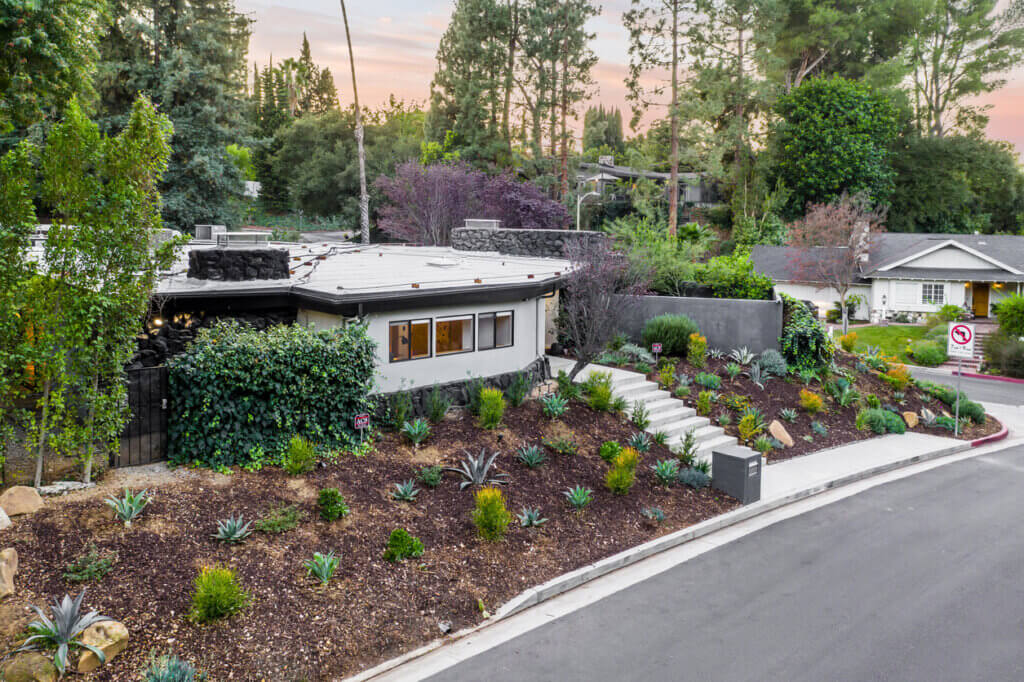
For residential properties, particularly iconic mid-century modern homes like Eichlers with their low-sloped, geometrically complex or stepped roofs, the main enemy is water and heat. Traditional flat roofs struggle with poor drainage, resulting in water pooling, or “ponding,” which severely decreases the roof’s lifespan. The thin insulation historically used in these structures also leads to high energy consumption because the roof acts as a huge heat absorber in the summer and allows heat to escape in the winter. Homeowners are constantly seeking effective drainage and insulation solutions that don’t spoil the architectural appeal.
For commercial and industrial property managers, the challenges escalate with size and equipment complexity. Flat or low-sloped commercial roofs commonly house numerous mechanical systems, such as HVAC units, piping, ductwork, skylights, and cooling towers. Each one of these features means a roof penetration, and every penetration is a potential leak point. Conventional built-up roofing (BUR) systems rely on multiple layers and seams or joints that are prone to separating due to temperature changes, allowing water and microbes to seep in. Furthermore, standard flashing materials around these rooftop features eventually fail due to degradation or expansion and contraction. When managers choose roofing based only on low initial cost rather than long-term effectiveness, they face constant repairs and the risk of costly interior damage if the roof fails.
The Architectural Superpower: How SPF Conforms to Anything
The power of Spray Polyurethane Foam (SPF) lies in its application process. SPF starts as two liquid components mixed together, which are then sprayed directly onto the existing roof surface. Once sprayed, this liquid immediately reacts and expands up to 30 times its original volume. This expansion process is the secret weapon for complex designs:
- Seamless Barrier: SPF creates a seamless monolithic barrier that completely covers the entire roof substrate. Because there are no joints or seams, the biggest weakness of traditional roofing systems, where water and air typically pass through, is eliminated.
- Total Conformity: The foam actively contours and adheres perfectly to most substrates or surfaces when installed, making it ideal for unique roof shapes. This versatility means SPF is suitable for flat, pitched, saw-toothed, domed, or unusual configurations.
- Air and Water Seal: As it expands, the foam fills every gap, crack, and crevice. This results in a watertight, airtight, and vapor-tight barrier that dramatically improves energy efficiency by preventing air infiltration (which accounts for up to 40% of energy loss in buildings).
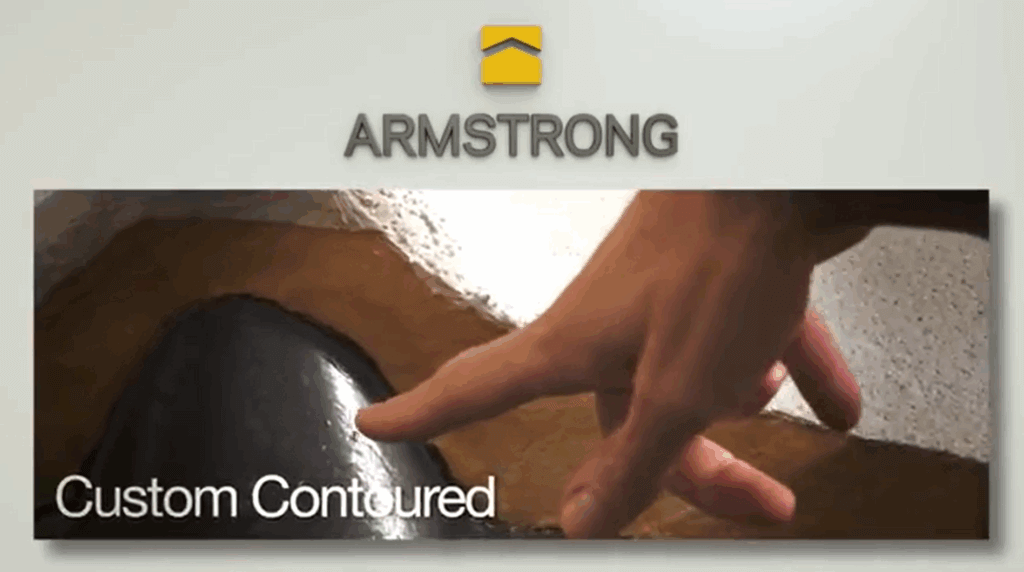
This unique application ensures that even the most irregularly shaped roofs, where installing sheets or multiple layers of material would be impossible, receive a complete, customized seal.
Solving the Complex Drainage Problem on Multi-Level Roofs
Multi-level commercial buildings and flat-roofed residences often suffer from poor drainage, leading to stagnant water, rot, and eventual leaks. This is especially true when a roof features multiple elevation changes or an insufficient slope.
SPF offers a dynamic solution to this problem, unlike passive roofing systems. During the application process, Armstrong’s skilled contractors can strategically increase the thickness of the foam layer in specific areas to build up low spots and create a positive slope. This custom contouring helps the water flow effectively off the roof towards drains and gutters, eliminating troublesome ponding water and reducing the unnecessary weight load caused by water accumulation.
Furthermore, spray foam roofing eliminates one of the most common leak sources in complex structures: faulty flashing. Flashing is the waterproofing used where the roof meets vertical structures (like walls, vents, and pipes). Because SPF conforms exactly to the substrate as it is applied, it creates a seamless seal ideal for flashing parapet walls, equipment, skylights, and cooling towers. This comprehensive, seamless sealing around every unique feature guarantees leak protection where traditional materials routinely fail.
The Lightweight Advantage for Structural Integrity
One serious concern for property owners, particularly those managing older residential buildings (like Eichler homes built under older codes) or large industrial complexes, is the structural load placed on the building. Traditional built-up roofing (BUR) systems are incredibly heavy, weighing about 600 pounds per 100 square feet. This heavy burden can place long-term stress on the underlying structure.
In contrast, Armstrong’s SPF roofing system, made of 3LB density closed-cell foam, is extremely lightweight, weighing only approximately 60 pounds per 100 square feet.
- Reduced Stress: This dramatic difference in weight minimizes the stress on your home’s building envelope and structural beams. For Eichler homeowners, upgrading to SPF offers peace of mind, knowing the roof is protected without putting undue strain on the decades-old structural framework.
- Ideal for Retrofits: Because the foam adheres easily to most materials and is ultra-lightweight, in most cases, it can be applied directly over existing, single-layer, structurally sound roofs, eliminating the need for expensive and environmentally wasteful tear-offs.
- Flexibility and Durability: Despite being ultra-lightweight, the closed-cell foam is rigid enough for foot traffic and has high compressive strength (up to 50 PSI). It is also highly flexible, allowing it to withstand the normal expansion and contraction caused by Bay Area temperature fluctuations, which prevents the cracking common with rigid materials and enhances resistance to seismic movement.
Case Study Spotlight: Protection for Unique Industrial/Commercial Structures
The unique physical properties of SPF have made it the ideal choice for protecting some of the world’s most irregularly shaped and challenging structures.
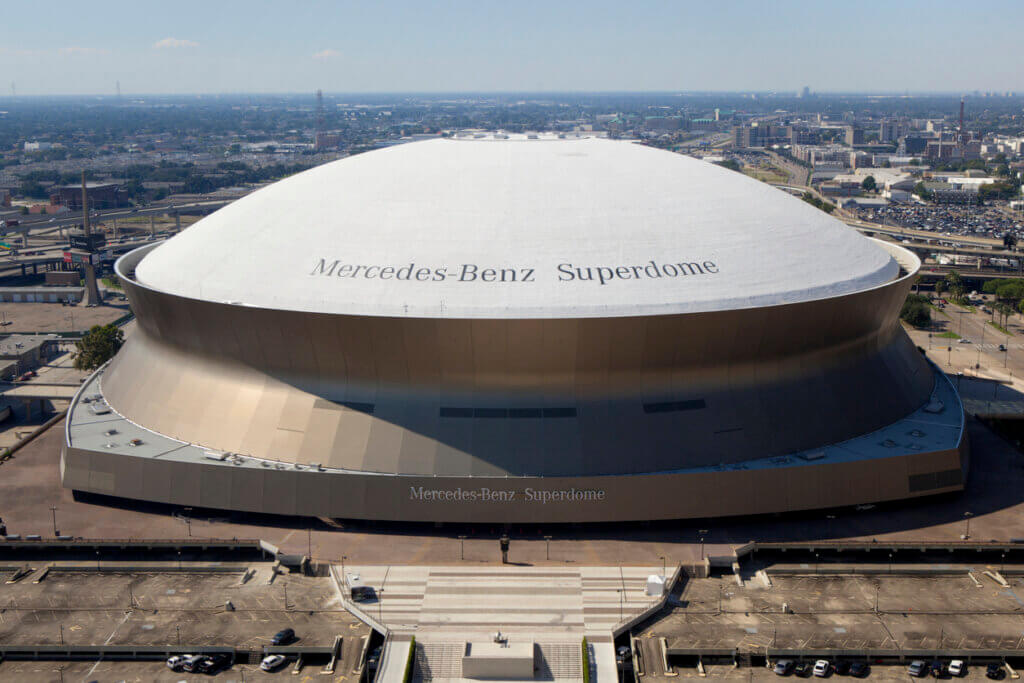
A clear example of SPF’s resilience on a complex shape is the Louisiana Superdome (now called the Caesars Superdome), one of the biggest fixed dome facilities globally. The Superdome originally utilized a polyurethane foam roof when it opened in 1975. Later, after replacing the foam with a single-ply EPDM membrane in 2003, the roof failed dramatically after just two years when Hurricane Katrina struck in 2005, with sub-100 mph winds blowing off most of the membrane. After more research, the facility decided to re-roof with sprayed polyurethane foam because testing showed that foam did not fail even at 200 mph winds. The application involved spraying a seamless, leak-resistant layer of closed-cell foam onto the 3,750 metal panels of the dome, demonstrating its ability to waterproof an immense, curved, complex surface effectively.
Another powerful, albeit hypothetical in the Bay Area, example is its application on US military tents in the Iraqi desert and Afghanistan, where temperatures reached 130 degrees Fahrenheit. Here, polyurethane foam was applied to air-conditioned tents to seal, insulate, and provide structural support in a severely challenging environment. This application shows the incredible flexibility and mobility of SPF as a combined water, air, vapor, and thermal control layer, providing a fast, efficient solution for complex or temporary industrial structures.
SPF’s proven tenacity in extreme conditions, combined with its ability to self-adhere and conform to any shape (from massive domes to sensitive military tents), makes it the top choice for Bay Area commercial and industrial facilities with equally challenging roofing needs, like those requiring multiple, reliable seals around heavy equipment or extensive pipe networks.
Integrating Modern Features: Solar Panels and Rooftop Equipment
Modern architecture frequently utilizes rooftops for features like extensive solar and HVAC arrays. These features introduce complex challenges related to flashing, weight, and the risk of physical damage to the roofing membrane.

SPF foam roofing is explicitly noted for its capacity to provide excellent seal and insulation for ductwork or any other rooftop installations. The seamless nature of the application completely eliminates leak pathways around these features, providing superior protection for multiple roof-level connections.
Unlocking Energy Efficiency and Lifelong Value
The long-term value of choosing Armstrong’s SPF system far surpasses the initial investment, regardless of your roof’s complexity. The foam density used by Armstrong is rated at 3LB closed-cell foam, ensuring high insulation values, strength, and durability.
Superior Energy Savings
SPF roofing provides superior insulation and is over 500% more energy efficient than conventional roofs like tar and gravel. This phenomenal efficiency is due to its high R-value (thermal resistance) combined with its monolithic nature, which creates a complete air barrier, stopping up to 40% of energy loss caused by air infiltration.
Cool Roof Technology
The reflective elastomeric white coatings applied over the foam create a “cool roof,” which can keep the roof surface temperatures as much as 50°F cooler in the summer sun, potentially reducing heating and cooling costs by up to 40%.
Rapid Return on Investment (ROI)
Research shows that the substantial energy savings realized from a foam roof can typically pay for the initial cost within 3 to 4 years.
Sustainable Longevity
Spray foam roofing is considered a sustainable system because it requires minimal maintenance. With proper care, SPF can last for decades or even a lifetime. You only need to recoat the protective elastomeric layer approximately every 15 to 20 years to shield the foam from UV rays and ensure it continues to perform like new. Moreover, since foam can often be applied directly over a sound existing roof, it eliminates the need for expensive tear-offs and reduces the amount of material waste sent to landfills.
Why Trust Armstrong Foam Roofing in the Bay Area
Choosing a roofing contractor with proven expertise is the most important factor in ensuring your SPF roof performs correctly, especially on complex architectural designs. Since the late 1970s, Armstrong Foam Roofing has been specializing in SPF systems and brings over 40 years of experience to every job. We proudly hold the title of having installed more residential foam roofing than any other company in America.
As a local family-owned and operated business serving the San Francisco Bay Area since 1966, we ensure that every installation follows a detailed 10-step process and uses top-quality 3LB closed-cell foam. We offer our clients some of the best and longest-lasting warranties available in the industry, including a 15-year warranty on our foam systems.
Our expertise allows us to provide this superior solution to residential, commercial, and industrial clients throughout the region, including San Francisco, Oakland, Emeryville, San Rafael, Palo Alto, Fremont, Dublin, Hayward, Livermore, Pleasanton, San Leandro, Union City, Cupertino, Gilroy, Milpitas, Mountain View, Santa Clara, Berkeley, South San Francisco, Daly City, Burlingame, San Jose, Novato, Santa Rosa, El Cerrito, Concord, Walnut Creek, and Danville.
Ready for Unparalleled Protection? Contact Armstrong Today!
If you are a property owner navigating the difficulties of protecting a unique or complex roof design in the San Francisco Bay Area, stop worrying about leaks, inefficient insulation, and structural stress. Armstrong Foam Roofing is the best investment for your home or commercial facility because our advanced SPF systems conform perfectly to any shape, provide unmatched waterproofing, and deliver energy savings that pay for the system itself.
Don’t let the complexity of your architecture lead to costly failures! Contact Armstrong Foam Roofing today to safeguard your investment with the definitive seamless roofing solution. Call us at (877) 796-1234 to schedule your FREE no-obligation Satellite Roof Estimate or arrange a remote consultation right now!
Frequently Asked Questions (FAQ) about SPF on Complex Roofs
Q1. How can SPF roofing handle curved or domed structures?
SPF is applied as a liquid that expands and conforms to the substrate, creating a custom-formed, seamless, and monolithic barrier over any shape, including flat, pitched, saw-toothed, and domed roofs, or those with unusual configurations.
Q2. Is SPF heavy enough to stress the structure of older or complex buildings?
No, SPF is extremely lightweight (about 60 lbs per 100 sq ft) compared to traditional BUR systems (about 600 lbs per 100 sq ft). This minimizes stress on the building’s structural framework, making it ideal for older structures and complex designs.
Q3. How does foam prevent leaks around rooftop equipment like HVAC units?
Since SPF is self-flashing, it adheres and seals effectively around complex features like skylights, cooling towers, ductwork, and parapet walls. This monolithic sealing eliminates the common leak points caused by faulty flashing in traditional, seamed materials.
Q4. Can a foam roof accommodate a rooftop garden (green roof)?
Yes, a foam roof can support a roof garden, but the structure must first be engineered to handle the additional load of soil, plants, and water. Crucially, specialized protective layers, like root barriers and drainage systems, must be installed above the SPF to prevent damage and uphold performance.
Q5. Can SPF eliminate standing water (ponding) issues on a low-sloped roof?
Yes. Experienced contractors like Armstrong can strategically apply a thicker layer of foam in low areas to create a positive slope, ensuring water drains efficiently and preventing ponding.
Q6. Is spray foam durable enough to handle foot traffic from maintenance crews?
Yes. The closed-cell foam used by Armstrong is 3LB density, offering high strength, and can sustain up to 50 pounds per square inch. This is strong enough to withstand regular foot traffic from technicians servicing rooftop equipment like HVAC units and compressors.