

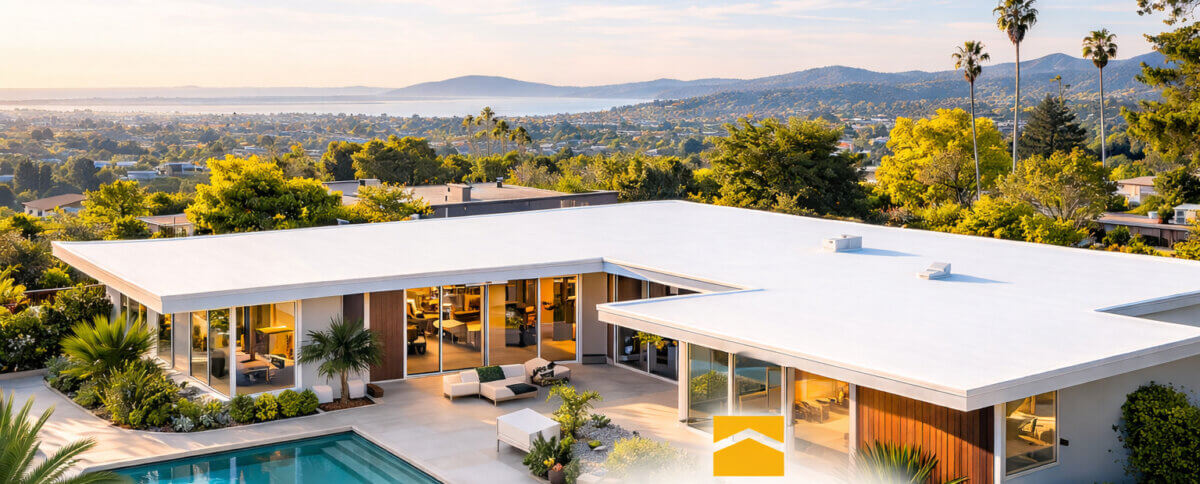
Joseph Eichler’s mid-century modern homes are more than just houses — they are architectural masterpieces that defined the California dream.
With their signature flat roofs, floor-to-ceiling glass, open post-and-beam construction, and seamless blend of indoor and outdoor living, these homes remain among the most coveted properties in the San Francisco Bay Area. Concentrated in communities like Palo Alto, San Rafael, San Jose, Walnut Creek, and Marin County, Eichler neighborhoods represent something genuinely rare: a vision of progressive, democratized architecture that has only grown more valuable with time.
Yet as any long-term Eichler owner will tell you, the very features that make these homes beautiful can also make them a challenge to maintain. The flat roofline — so essential to that iconic silhouette — is both the home’s defining characteristic and its most persistent vulnerability. At Armstrong Foam Roofing, we have spent over four decades perfecting the solution to this challenge: Spray Polyurethane Foam (SPF). Tested and proven for more than 40 years, this advanced technology is specifically designed to protect the integrity of your Eichler while transforming it into a fortress of comfort, efficiency, and lasting value. The SPF Roofing System is so well-regarded that it is highly recommended by the Eichler Network, whose primary mission is the preservation of Eichler purity and design integrity.
The Eichler Struggle: Four Costly Problems
Eichler homes were designed with a minimalist aesthetic, utilizing flat or very low-sloped roofs with wide overhangs. While this looks sleek, it creates a set of functional problems that traditional roofing materials are simply not equipped to solve.
Drainage failures. Unlike a pitched roof that sheds water naturally, a flat Eichler roof has nowhere for rainwater to go except to sit. Traditional Built-Up Roofing (BUR) — such as tar and gravel — relies on multiple layers of felt and hot asphalt held together by seams, and those seams are notoriously vulnerable. Over time, the Bay Area’s temperature swings cause the rigid materials to expand and contract, pulling seams apart and cracking the asphalt. Once a seam fails, water finds its way into the structure, leading to wood rot, mold, and damaged drywall throughout the home.
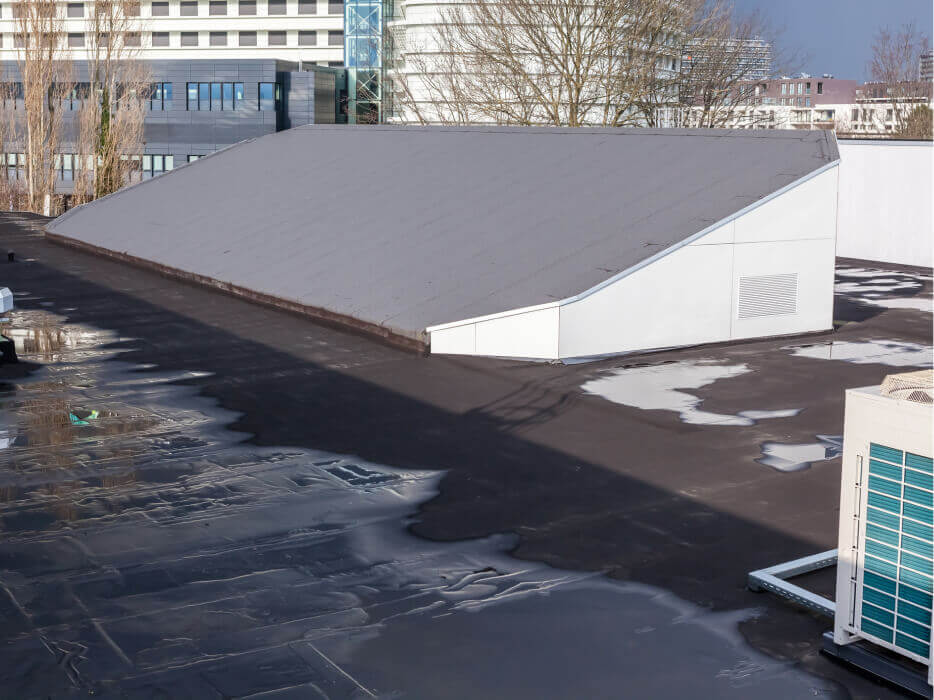
Chronic ponding water. Because these roofs are truly flat, they frequently suffer from “ponding water” — stagnant pools that sit for days after a rain event, putting immense hydraulic pressure on the roof membrane and inviting leaks, algae growth, and accelerated material degradation.
Inadequate insulation. Many Eichler roofs were built with very thin insulation by today’s standards. The result is a home that bleeds energy year-round — overheating in summer and losing warmth in winter. Utility bills climb steadily while interior comfort suffers, a problem that only worsens as energy costs rise.
“Heavy roofing systems can also put dangerous stress on an Eichler’s building envelope — the post-and-beam construction that was never engineered to carry the burden of a traditional 600-pound tar and gravel roof.”
Structural weight. A standard tar and gravel BUR system can weigh as much as 600 pounds per 100 square feet. Many Eichler homes, with their elegant post-and-beam frames, were never designed to carry that kind of sustained load — a concern that becomes even more critical in a seismically active region like the Bay Area.
What is Spray Foam Roofing?
Imagine a material that starts as a liquid and, within seconds of being applied, expands up to 30 times its original size to fill every single crack, gap, and irregularity on your roof’s surface. That is SPF. It isn’t just a covering — it is a high-tech, monolithic shield that conforms perfectly to the unique geometry of your Eichler, bonding directly to the substrate and becoming a seamless, continuous part of the structure itself.
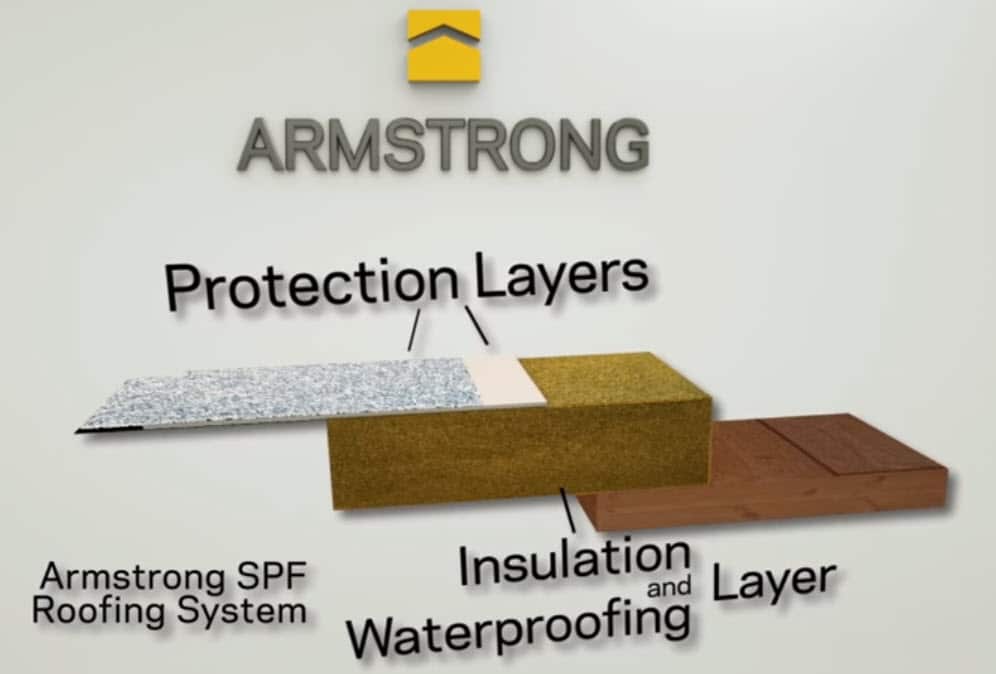
Armstrong uses a high-density 3LB closed-cell foam. Unlike the soft, open-cell foam found in furniture cushions, this material is exceptionally rigid, stable, and impermeable. It is dense enough to walk on comfortably and creates an impenetrable barrier against both air and moisture infiltration. To shield the foam from UV degradation, our crews apply two layers of a specialized UV-protective elastomeric coating, finished with a layer of durable ceramic granules. The result is a complete roofing system — insulation, waterproofing, and weatherproofing all in a single seamless application.
Critically, unlike traditional BUR systems where a single puncture can allow water to travel horizontally and silently beneath the surface, a damaged area in an SPF roof remains localized. The closed-cell structure contains any breach to the immediate vicinity, making it easy to spot and repair — without tearing off the entire roof.
The 500% Difference
Eichler homes are notorious for being “energy sieves.” Built in an era when insulation was an afterthought, their thin roof assemblies allow conditioned air to escape year-round. SPF is the first truly intelligent roofing technology because it solves insulation and waterproofing simultaneously — in a single application, with no trade-offs.
SPF provides the highest R-value per inch of any commercially available roofing material, meaning it resists heat transfer more effectively than anything else on the market. But the real breakthrough is its air-sealing capability. Studies show that up to 40% of a building’s total energy loss occurs through small gaps and cracks — the same gaps that SPF expands to fill completely. The result is an airtight thermal envelope that lets your HVAC system work a fraction as hard as it used to.
Bay Area homeowners with SPF roofs consistently report heating and cooling savings of 30 to 50%. Given that kind of reduction in utility costs, an Armstrong SPF roof typically pays for itself within just 3 to 4 years — and then continues delivering savings for decades more.
HVAC costs
pay for itself
conventional roofs
SPF vs. Traditional Roofing
The numbers tell the story clearly. Across every meaningful performance category, Armstrong’s SPF system delivers results that traditional tar and gravel simply cannot match — especially for the unique demands of a flat-roofed Eichler.
Preserving the Mid-Century Aesthetic
Replacing an Eichler roof shouldn’t mean compromising its iconic look. Traditional gravel roofs are bulky and dark, absorbing solar heat and visually disrupting the home’s clean, low-profile silhouette. Many Eichler owners have hesitated to re-roof precisely because they feared the result would alter the character of their home.
Armstrong’s SPF system is applied as a thin, conforming layer — preserving the precise roofline Eichler intended. Our Armstrong Weather-Guard System (AWS) coatings are available in white, light grey, and tan finishes, all of which complement the mid-century palette. The white reflective option not only looks sharp but actively works to maintain a cooler interior temperature by bouncing harmful UV solar rays back into the atmosphere rather than absorbing them into your home’s structure. The overall effect is a roof that looks cleaner and more refined than the original, while performing at a level Eichler’s era could never have imagined.
Minimal Maintenance.
Maximum Lifespan.
Most homeowners have been conditioned to accept that a roof is a 10 to 15-year depreciating asset — a costly cycle of deterioration, emergency repairs, and eventual full tear-off. Armstrong SPF roofing breaks that cycle entirely. Classified as a 50-year sustainable roofing system, SPF requires only a fraction of the attention that traditional materials demand, and it never needs to be torn off and sent to a landfill.
-
01Bi-Annual Inspections A quick visual check each spring and fall is all that’s needed — look for any accumulated debris or rare impact damage from overhanging tree branches. Most Eichler owners can do this themselves in minutes.
-
02Keep Drains Clear Ensure gutters and roof drains stay free of leaves and debris so that the contoured slope can do its job. Unobstructed drainage is the simplest and most effective maintenance step for any flat roof.
-
03Recoat Every 15–20 Years The only scheduled maintenance the system requires is refreshing the UV-protective elastomeric topcoat approximately every 15 to 20 years. This single step rejuvenates the entire roof and extends its performance life by another two decades — no demolition, no waste, no disruption to your home.
By eliminating the tear-off and landfill disposal cycle that traditional roofing demands, SPF is also the most environmentally responsible roofing choice available. Fewer replacements means fewer tons of roofing waste entering Bay Area landfills — a benefit that aligns with the forward-thinking values Eichler himself championed.
Why Choose the Bay Area’s Foam Roofing Experts?
An SPF roof is only as good as the crew that installs it. Spray foam roofing demands specialized equipment, precise calibration, and a deep technical understanding of both the materials and the structures they’re applied to. There is no shortcut, and there is no substitute for experience.
Armstrong Foam Roofing has been a family-owned and operated California business since 1966. Founded by Hal Armstrong and built to prominence by Howard Armstrong, the company is now in its third generation — and the core philosophy remains unchanged: deliver the highest quality products, installed by professionals who take genuine pride in their work. Since the late 1970s, Armstrong has installed more residential foam roofing systems than any other company in America, accumulating millions of applicator hours across tens of thousands of Bay Area homes and commercial buildings.
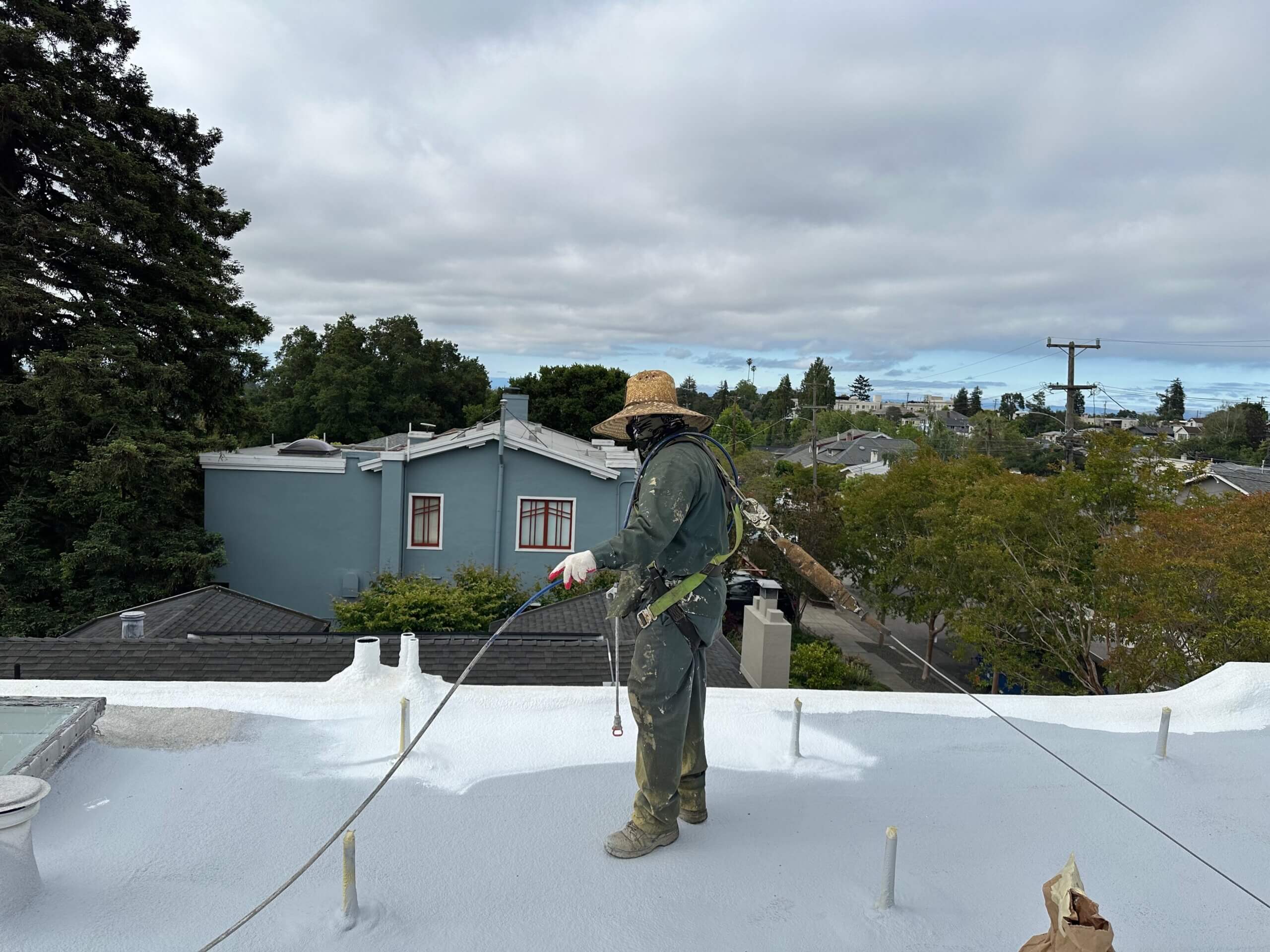
That experience is codified in the Armstrong Weather-Guard System (AWS) — our proprietary installation standard that ensures every roof is optimized for both immediate performance and long-term life-cycle durability. It represents not just a set of materials, but the accumulated knowledge of over half a century of field experience, refined project by project across Northern California.
We back every installation with a 15-year warranty — one of the strongest in the industry — because we install every roof according to manufacturer specifications and leave nothing to chance. Other contractors may offer similar warranty terms on paper, but many won’t be in the foam roofing business long enough to honor them. Armstrong has been keeping its promises to Bay Area homeowners for more than 50 years or even a lifetime, and we will be here for you through the full lifecycle of your roof.
We also make getting started as simple as possible. Armstrong offers a no-obligation Satellite Roof Estimate — we can assess your roof remotely and provide a professional estimate without you needing to schedule a visit. Free consultations are available by phone, video call, or in person, whichever you prefer. And with 0% financing available for 12 months for qualified applicants, protecting your Eichler has never been more accessible.