

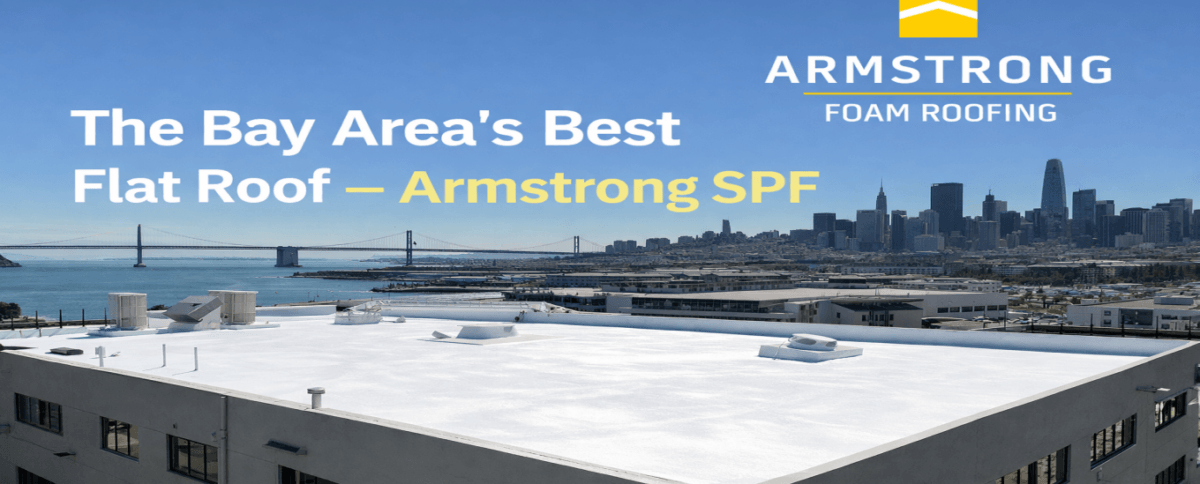
If you own or manage a commercial building, apartment complex, or flat-roofed home anywhere in the San Francisco Bay Area, you already know the roof over your head works harder than almost anywhere else in the country. Coastal fog rolls in from the Pacific, creating persistent moisture and humidity cycles. Winter atmospheric rivers dump inches of rain in hours. Summer UV exposure, despite the fog, quietly degrades roofing membranes year after year. And let’s not forget that the Bay Area sits squarely astride some of the most seismically active fault lines on the planet. A flat or low-slope roof here isn’t just a cover; it’s a critical system that must handle all of the above while keeping your energy bills in check.
The bad news: most flat roofing systems installed on Bay Area buildings today were chosen for their upfront price tag, not their long-term performance. The result is a parade of premature failures, pooling water, energy loss through aging insulation, and re-roofing bills that dwarf the original installation cost.
The good news: one roofing technology has quietly solved all of these problems simultaneously. Spray Polyurethane Foam (SPF) roofing, and specifically the closed-cell, high-density systems installed by Armstrong Foam Roofing, delivers insulation, waterproofing, structural reinforcement, and energy savings in a single seamless application. By the time you finish this guide, the data will speak for itself.
This article compares every major flat roofing option available in 2026 on the metrics that matter most to Bay Area property owners: total cost of ownership, lifespan, energy performance, leak resistance, seismic resilience, and environmental impact.
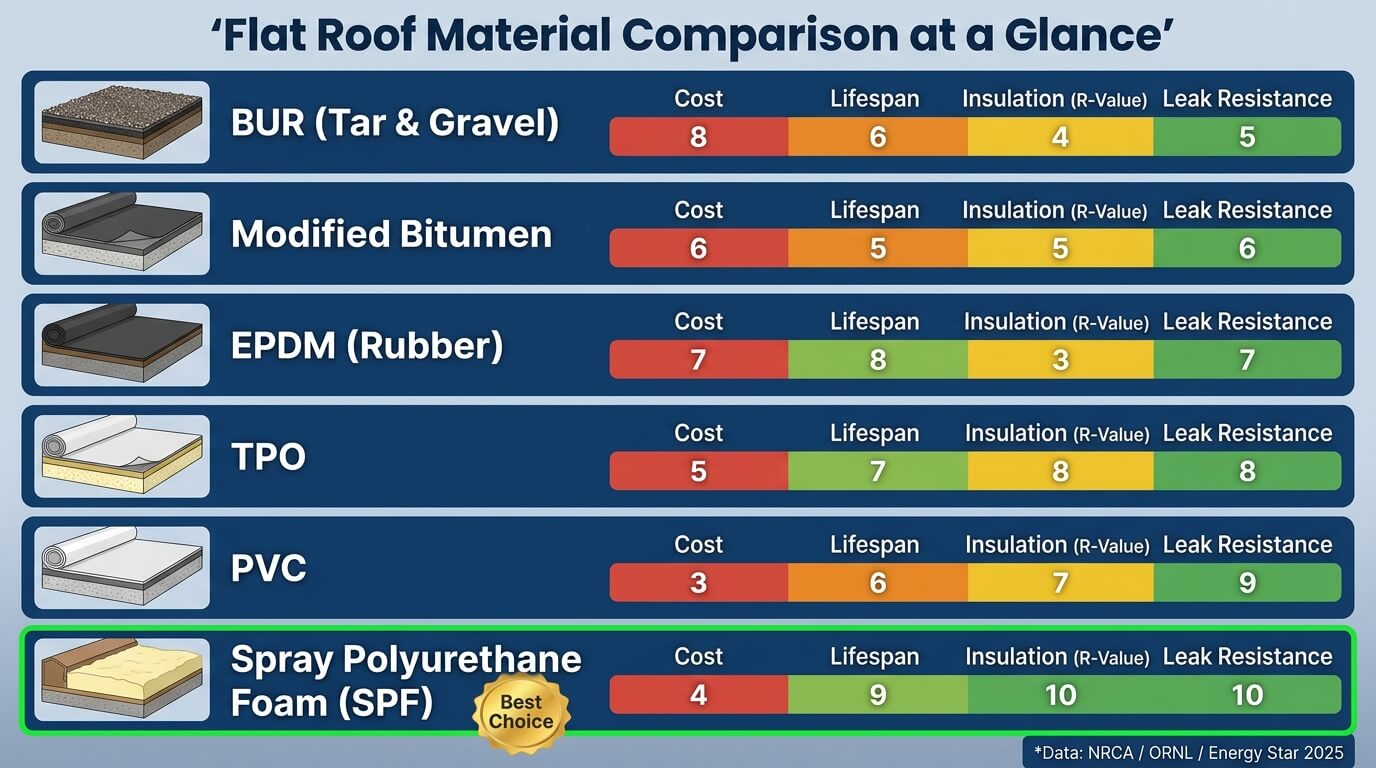
(Higher = better. “Cost” is reversed: 10 = Lowest Cost, 1 = Highest)
Understanding Flat and Low-Slope Roofs in the San Francisco Bay Area
Flat and low-slope roofs, defined by the National Roofing Contractors Association (NRCA) as roofs with a pitch between 0:12 and 3:12, account for a substantial share of the Bay Area’s commercial and multi-family building stock. Decades of dense urban development, warehouse conversions, and mid-century commercial construction mean hundreds of thousands of square feet of low-slope roof surface exist across San Francisco, Oakland, San Jose, Napa, Marin County, and the wider nine-county region.
What Makes the Bay Area Uniquely Demanding for Flat Roofs?
- Seismic movement: The Hayward Fault, San Andreas Fault, and numerous secondary faults regularly produce tremors. Even minor seismic activity causes roofing membranes with seams to crack, delaminate, or lift at attachment points.
- Thermal cycling: Bay Area buildings experience abrupt temperature swings, cold, damp mornings followed by warm afternoons, which expand and contract roofing materials daily, accelerating fatigue at seams and field areas.
- Persistent moisture: San Francisco averages roughly 23 inches of rainfall annually, concentrated in the October–April wet season. Coastal fog adds ambient moisture year-round. Standing water on improperly sloped flat roofs is a guaranteed leak waiting to happen.
- Energy costs: Pacific Gas & Electric (PG&E) commercial electricity rates rank among the highest in the continental United States. A poorly insulated roof is a direct, ongoing drain on the bottom line.
- High winds: Coastal and East Bay gap winds regularly gust above 40 mph, creating negative wind-uplift pressure that can peel improperly secured roofing membranes.
Against this backdrop, the roofing material chosen for a Bay Area flat roof must outperform options designed for more forgiving climates.
The Main Flat Roofing Options Available Today
Here is a data-grounded overview of the six primary flat roofing systems the Bay Area market offers in 2026.
1. Built-Up Roofing (BUR / Tar and Gravel)
Built-Up Roofing is one of the oldest commercial roofing systems still in active use. It is constructed by layering multiple plies of bitumen-saturated felt or fiberglass mats, with each layer mopped down in hot asphalt or coal tar pitch. A final aggregate (gravel or slag) ballast layer provides UV protection.
- Typical installed cost: $4–$8 per square foot, depending on the number of plies and local labor rates.
- Lifespan: 15–30 years with regular maintenance. Highly dependent on installation quality and drainage.
- Bay Area concerns: BUR systems are heavy, often 3–6 lbs per square foot added dead load, which can stress older building structures. The hot-mopping process produces significant fumes and VOC emissions. Seismic movement can crack the brittle bitumen layers. The multiple seams and laps are chronic leak points in the high-rainfall Bay Area environment.
- R-value: BUR provides minimal intrinsic insulation (approximately R-1 per inch of bitumen). A separate insulation layer must be specified and installed underneath.
2. Modified Bitumen
Modified Bitumen roofing is an evolution of BUR technology. Factory-modified asphalts, either APP (Atactic Polypropylene) or SBS (Styrene-Butadiene-Styrene), are reinforced with polyester or fiberglass mats and come in pre-fabricated rolls. Installation uses torch-applied, hot-mopped, self-adhered, or cold-process methods.
- Typical installed cost: $4–$8 per square foot.
- Lifespan: 15–25 years.
- Bay Area concerns: SBS-modified products have reasonable flexibility in cold weather, which helps, but the system still relies on seamed laps. Torch application poses fire risk, and even cold-applied systems require careful detailing around penetrations. In heavy Bay Area rain events, a single failed lap seam can admit significant water intrusion.
3. EPDM (Ethylene Propylene Diene Monomer / Rubber Roofing)
EPDM is a synthetic rubber membrane available in large sheets (up to 50 feet wide), which reduces but does not eliminate seams. It can be installed fully adhered, mechanically fastened, or ballasted.
- Typical installed cost: $4–$8 per square foot.
- Lifespan: 20–30 years with proper maintenance.
- Advantages: Relatively good flexibility, ozone resistance, and proven longevity. Widely available and well-understood by Bay Area roofing contractors.
- Bay Area concerns: EPDM seams rely on contact cement or tape adhesives that can degrade under Bay Area UV and thermal cycling. The dark black surface (standard) absorbs heat, increasing cooling loads, which is directly counterproductive given high PG&E rates. White EPDM is available but costs more.
4. TPO (Thermoplastic Polyolefin)
TPO is a single-ply thermoplastic membrane, heat-welded at seams, available in white or light gray. It has gained substantial market share since the 1990s and is now one of the most commonly specified commercial roofing products in the United States.
- Typical installed cost: $5–$10 per square foot.
- Lifespan: 15–25 years, though early-generation TPO formulations were notorious for premature aging and seam failures. Modern third-generation TPO is more stable.
- Advantages: White reflective surface qualifies for Energy Star and LEED credits. Heat-welded seams are stronger than glued seams. Lightweight (approximately 0.5 lbs per square foot).
- Bay Area concerns: TPO seam failures remain a leading cause of commercial roof leaks. While heat-welded seams are strong when installed correctly, their quality is highly dependent on the installer’s technique and the ambient temperature during installation, a real variable in the Bay Area’s cool coastal conditions. The membrane itself offers minimal intrinsic insulation.
5. PVC (Polyvinyl Chloride)
PVC single-ply membranes are plasticized thermoplastic sheets, also heat-welded at seams. They have a longer track record than TPO and offer strong chemical resistance, which is a benefit for rooftops with grease exhaust venting from restaurant kitchens.
- Typical installed cost: $6–$12 per square foot.
- Lifespan: 20–30 years.
- Advantages: Strong chemical and puncture resistance. Reflective surface for energy savings. Heat-welded seams.
- Bay Area concerns: PVC contains plasticizers that can migrate out of the membrane over time, making it brittle, particularly in rooftops exposed to significant UV cycling. Higher initial cost than TPO. Still relies on seams that must be perfectly welded to prevent leaks. PVC is not recyclable in most municipal programs and has a higher environmental footprint than other options.
6. Spray Polyurethane Foam (SPF) — Armstrong Closed-Cell Systems
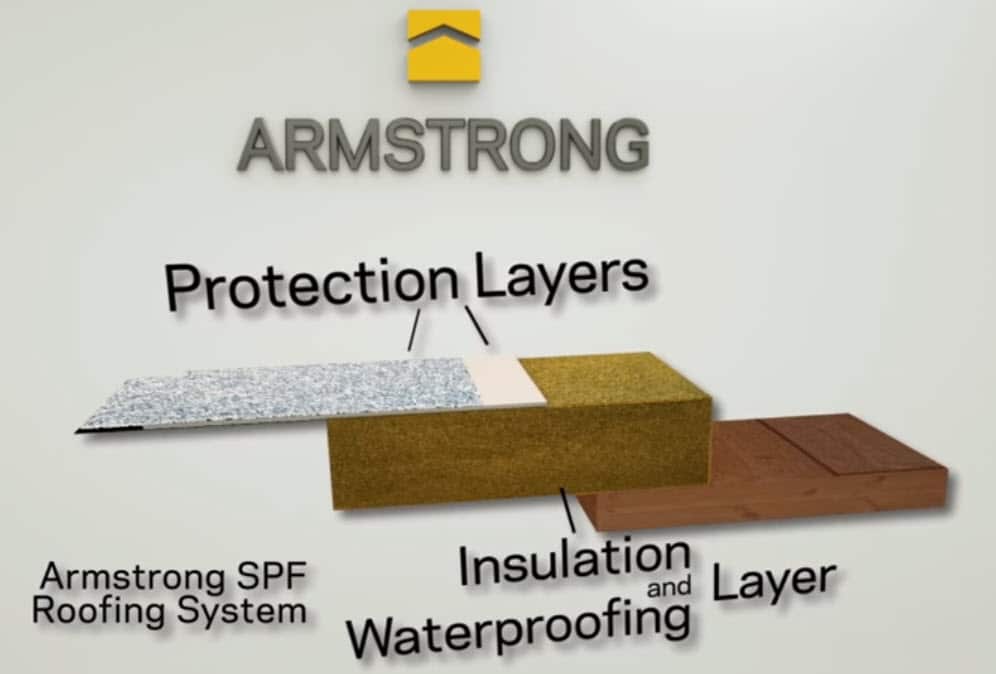
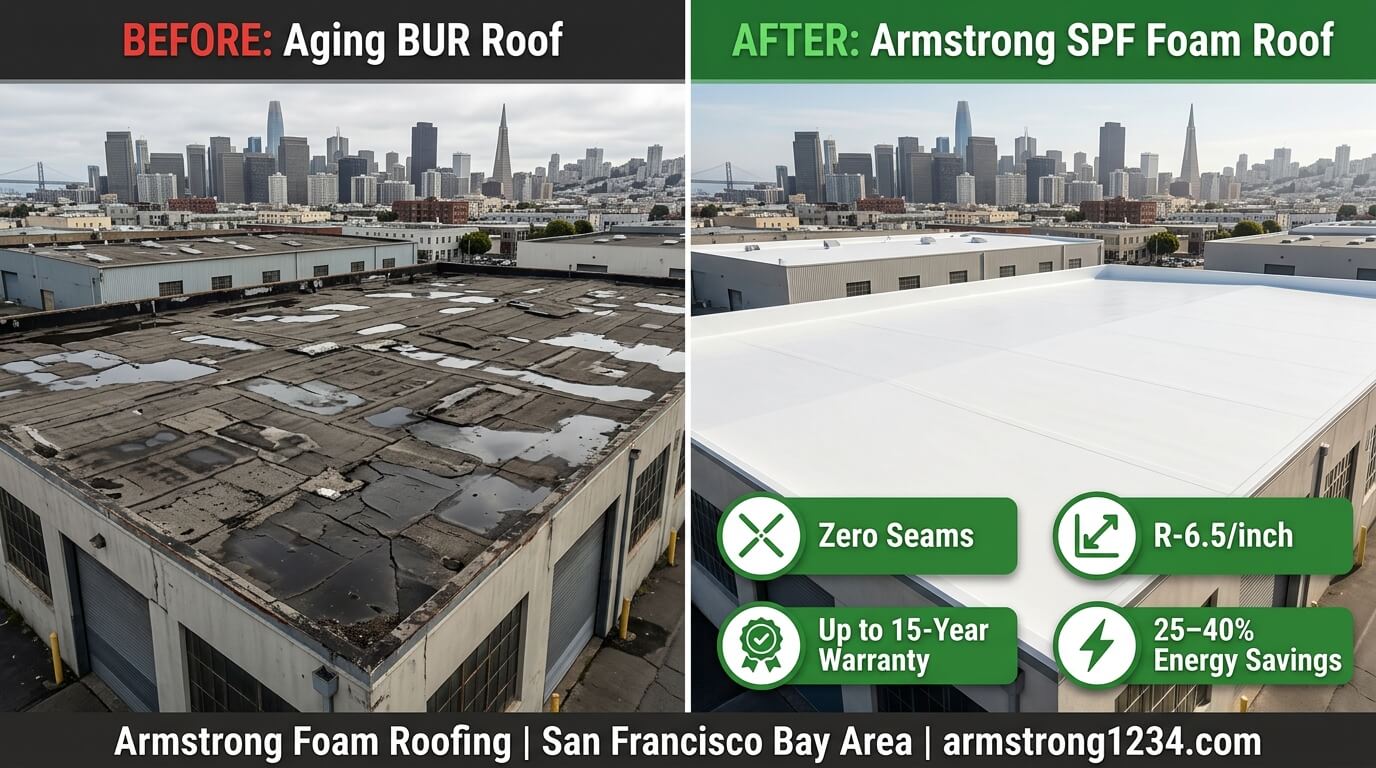
Spray Polyurethane Foam roofing is the most advanced flat roofing technology available today, and Armstrong Foam Roofing has been refining and installing SPF systems across the San Francisco Bay Area for years. Unlike every other system described above, SPF is applied as a two-component liquid that self-expands into a rigid, closed-cell foam monolith which is completely seamless, self-flashing around every penetration, and insulating at the industry’s highest R-value per inch.
- Typical installed cost: $5–$9 per square foot, including the protective elastomeric coating layer.
- Lifespan: 50+ years with periodic recoating (typically every 15–20 years at a fraction of the original cost).
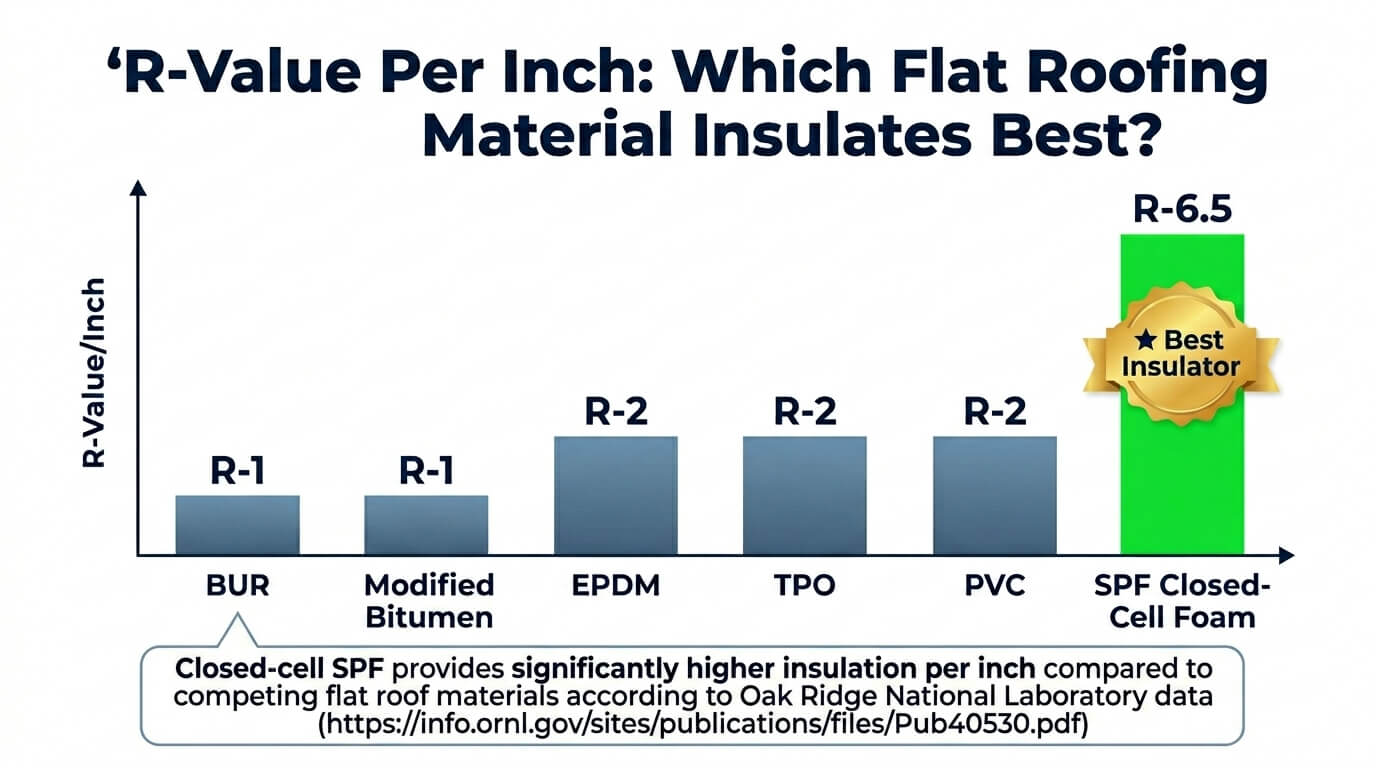
- R-value: Approximately R-6.5 per inch of closed-cell foam, more than three times the insulating value of any competing flat-roof material.
- Seamless monolithic membrane: With zero seams, laps, or mechanical fasteners in the field, the single most common source of flat roof leaks is simply eliminated.
- Self-leveling slope correction: SPF can be applied in varying thicknesses to create positive drainage slopes on roofs that previously had none, permanently solving the pooling-water problem without expensive structural modification.
- Lightweight: Closed-cell SPF adds approximately 0.5–1.5 lbs per square foot, significantly less than BUR or modified bitumen systems, preserving structural capacity.
- Bay Area-specific performance: The closed-cell foam matrix is inherently flexible enough to accommodate seismic movement without cracking, remains stable through thermal cycling, and bonds monolithically to the substrate to resist wind uplift forces that defeat mechanically fastened membranes.
Head-to-Head Comparison: Why Armstrong Spray Foam Roofing Dominates
The table below compares all six major flat roofing systems on the key performance, economic, and environmental metrics that Bay Area property owners care about most. All cost figures are 2025–2026 Bay Area market estimates. Armstrong SPF entries are highlighted in green.
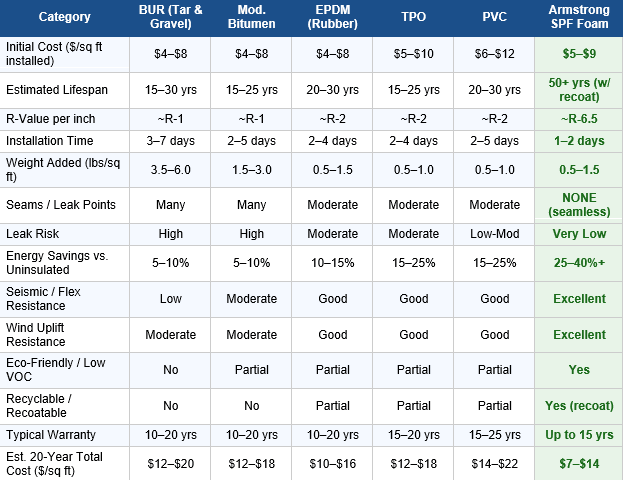
Sources: NRCA Roofing Manual (2024 ed.); Oak Ridge National Laboratory Whole-Wall R-Value data; Energy Star Reflective Roof Products database; RSMeans Cost Data (2025).
Key takeaway: Armstrong SPF foam roofing is the only system in this comparison that wins or ties in almost every single performance category. Its 20-year total cost of ownership ($7–$14/sq ft) is the lowest of all six options once re-roofing, maintenance, and energy savings are factored in, not the highest.
Scientific Evidence and Verifiable Statistics
Insulation and Thermal Performance
The U.S. Department of Energy’s Oak Ridge National Laboratory (ORNL) has published extensive research on the thermal performance of commercial roofing systems. Closed-cell SPF consistently achieves an aged R-value of approximately R-6.5 per inch, a figure confirmed by independent Advancing Standards Transforming Markets (ASTM) C518 testing. This compares to approximately R-2 per inch for EPS or XPS board insulation commonly paired with TPO or PVC, and R-1 or less per inch of BUR bitumen.
Unlike rigid board insulation under a single-ply membrane, SPF completely eliminates thermal bridging, the phenomenon where heat travels through fasteners, metal decks, and gaps between insulation boards, degrading the real-world effective R-value of the roof assembly by 20–40%. SPF bonds directly and continuously to the substrate, leaving no air gaps, no fastener penetrations through the insulation layer, and no seams through which thermal energy can bypass the insulation.
Energy Savings in the Bay Area Context
According to the U.S. Environmental Protection Agency’s Energy Star program, cool roofs with reflective coatings can reduce peak cooling demand by 10–15% in warm climates. When reflective coatings are applied over high-R-value SPF, field studies and DOE modeling consistently show combined energy savings of 25–40% or more on air conditioning and heating loads compared to an uninsulated or under-insulated roof.
For a Bay Area commercial property spending $40,000 per year on energy, even a conservative 20% reduction represents $8,000 annually, or roughly $160,000 over 20 years. That figure alone can exceed the entire cost of an Armstrong SPF installation on a mid-sized building.
Wind Uplift and Seismic Performance
FM Global’s wind uplift approval standards (FM 4470 and FM 4474) evaluate roofing systems under rigorous simulated wind loading. Mechanically fastened and adhered single-ply systems must achieve specific uplift ratings based on building height and location. Fully adhered SPF systems, by bonding continuously and monolithically to the substrate, have demonstrated wind uplift resistance values that meet or exceed FM Global Class 1-90 and higher classifications in independent testing.
Seismic resilience testing confirms that closed-cell SPF’s inherent flexibility (elongation at break exceeding 300% per ASTM D412) allows it to move with a building during seismic events without cracking, delaminating, or losing waterproofing integrity, a critical advantage over brittle BUR or modified bitumen systems.
Fire Ratings
Armstrong SPF systems, when installed with approved elastomeric coating layers, achieve Class A fire ratings per ASTM E108 testing, the highest fire resistance classification for roofing materials. This is the same classification achieved by TPO and PVC systems and is a requirement for most Bay Area commercial building permits.
Environmental Profile
Modern water-blown or zero-ODP (Ozone Depletion Potential) blowing agents used in current-generation SPF formulations have eliminated the HFC concerns associated with earlier foam systems. Because SPF can be recoated rather than torn off and replaced, it generates essentially zero roofing tear-off waste, a significant advantage given California’s aggressive construction-waste diversion requirements under CalGreen (CALGreen Building Standards Code). Studies suggest that a single BUR re-roofing project on a 50,000 sq ft commercial building can generate 150,000–300,000 lbs of tear-off waste sent to landfill. SPF recoating generates virtually none.
Why Armstrong Foam Roofing Is the Smartest Choice for Bay Area Property Owners
Understanding SPF technology is one thing. Choosing the right contractor to install it is equally important. Armstrong Foam Roofing brings a combination of technical expertise, local Bay Area knowledge, and proven installation systems that distinguish our work from general roofing contractors who offer SPF as one of many services.
Armstrong’s Competitive Advantages
- Seamless, monolithic closed-cell system: Armstrong installs only high-density, two-component closed-cell SPF with a minimum compressive strength of 40 psi (ASTM D1621), the grade specified for roofing applications. This is not the lower-density open-cell foam used in wall insulation.
- Integrated slope correction: Armstrong’s applicators are trained to build positive drainage into every installation, tapering the foam to eliminate ponding water zones identified in the pre-installation roof survey.
- Rapid installation, minimal disruption: A full SPF roof installation typically completes in a matter of a few days for standard commercial buildings, compared to three to seven days for BUR. For occupied buildings and businesses, this dramatically reduces operational disruption.
- Long-term cost certainty: Armstrong’s recoat programs provide a documented maintenance pathway that can extend the original SPF installation to 50 years or a lifetime with proper maintenance, at a fraction of re-roofing cost. No tear-off. No landfill. Just a fresh protective coating layer.
- Local Bay Area expertise: Armstrong’s teams understand the specific permit requirements, wind zones, seismic details, and energy codes of Bay Area municipalities from San Francisco’s Department of Building Inspection to Santa Clara County and beyond.
- Virtual Estimate: We offer the option of virtual estimates, leveraging satellite technology for quick and precise evaluations of your roofing needs.
- Warranty coverage: Armstrong SPF systems are available with manufacturer-backed warranties of 15 years because we always install our foam roofing systems according to the specifications recommended by the manufacturer. Therefore, we givi property owners and their lenders documented long-term protection.
Case Studies: Armstrong SPF in Action Across the Bay Area
Case Study 1: Camino Storage — Commercial Roof Restoration (Santa Clara, CA)
A large-scale self-storage facility in Santa Clara required a cost-effective alternative to full roof replacement after years of leaks, ponding water, and declining thermal performance from an aging flat roofing system.
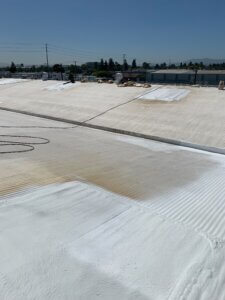
Rather than recommending a disruptive tear-off, Armstrong Foam Roofing engineered a closed-cell spray polyurethane foam (SPF) roof restoration applied directly over the existing substrate. This approach converted a failing roof into a seamless, fully adhered, high-R-value system in a fraction of the time required for traditional flat roofing replacement.
Key performance outcomes:
- Seamless monolithic membrane eliminated all primary leak pathways common in TPO, EPDM, and modified bitumen systems
- Integrated slope correction resolved chronic ponding water without structural modifications
- R-6.5 per inch insulation significantly improved energy efficiency and reduced HVAC load
- Zero tear-off avoided landfill waste and reduced total project cost
- Minimal operational disruption during installation
This project reinforces why SPF is one of the most effective flat roof restoration solutions in the San Francisco Bay Area, particularly for commercial properties seeking to avoid costly re-roofing cycles.
Case Study 2: Cross Church — Commercial Roofing Project (Napa, CA)
A large church facility in Napa required a long-term roofing solution capable of addressing seam-related failures, improving insulation, and withstanding Northern California’s moisture cycles and temperature fluctuations.
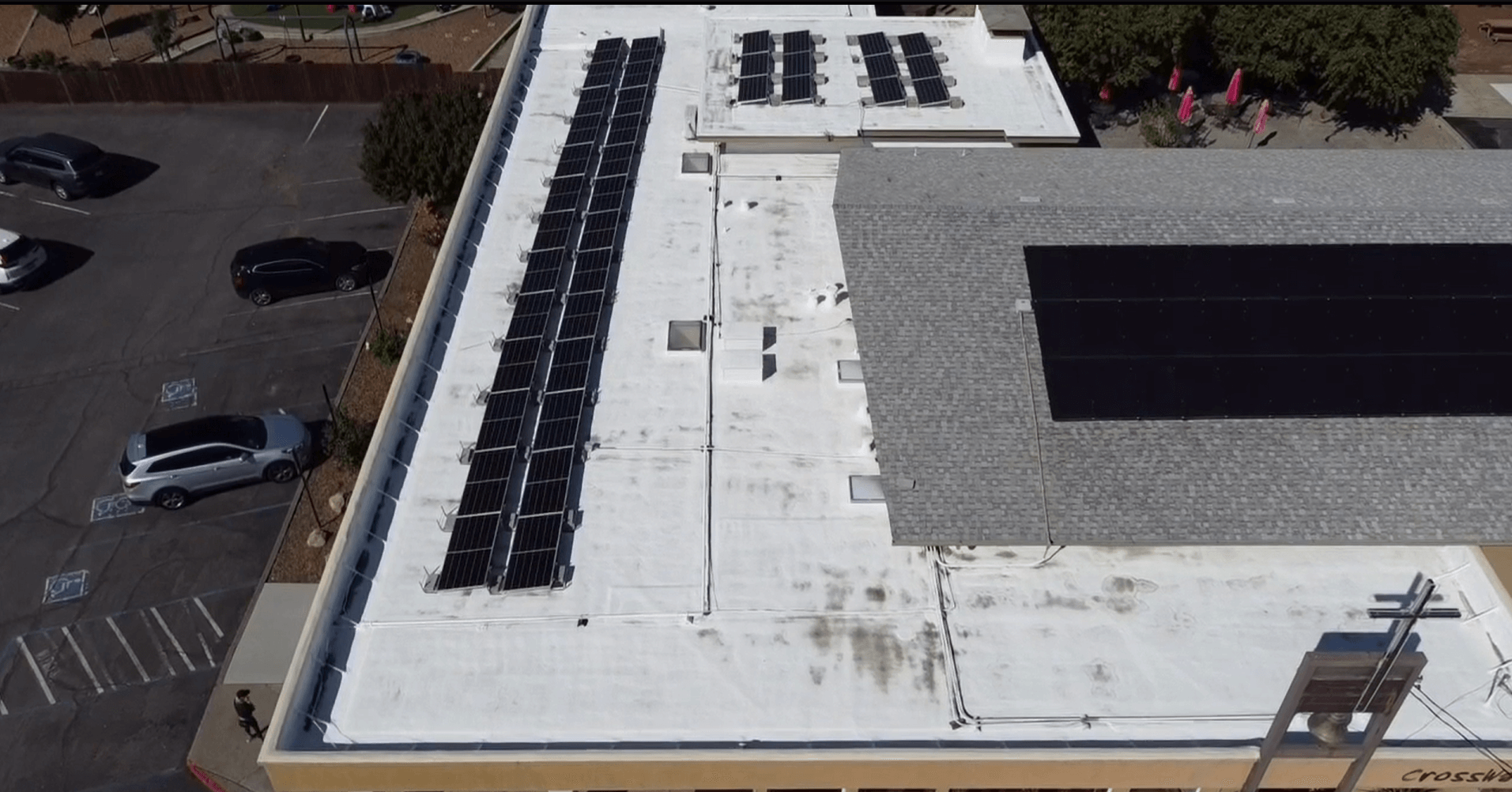
Armstrong Foam Roofing installed a high-density closed-cell SPF roofing system, creating a continuous, self-flashing membrane across all roof penetrations, transitions, and field areas, eliminating the primary failure points found in traditional flat roofing systems.
Key performance outcomes:
- Zero seams or mechanical fasteners, dramatically reducing long-term leak risk
- Superior thermal performance, lowering heating and cooling costs year-round
- Lightweight system, preserving structural load capacity compared to BUR systems
- Rapid installation timeline, minimizing disruption to building use
- Recoatable system design, enabling a 50+ year service life without full replacement
This installation demonstrates how SPF outperforms conventional materials like PVC, TPO, and EPDM in demanding Bay Area commercial roofing environments, particularly for institutional and assembly-use buildings.
Common Myths About Spray Foam Roofing: Busted
Myth 1: “Spray foam roofs are fragile and easily damaged.”
Reality: Armstrong’s closed-cell SPF has a minimum compressive strength of 40 psi per ASTM D1621 which is strong enough to walk on for routine maintenance. The protective elastomeric coating provides impact resistance and UV stability. High-density closed-cell foam is fundamentally different from low-density open-cell foam, which is used for interior insulation and is not suitable for roofing applications.
Myth 2: “Spray foam roofs are expensive.”
Reality: As the comparison table above shows, the 20-year total cost of ownership for Armstrong SPF ($7–$14/sq ft) is the lowest of all six systems evaluated. This accounts for energy savings, the elimination of re-roofing tear-off costs, minimal maintenance requirements, and the value of a 50-year warranty. Evaluating roofing purely on day-one installation price is the calculation that leads to decades of expensive re-roofing cycles.
Myth 3: “Spray foam roofs need constant maintenance.”
Reality: SPF roofs require periodic recoating every 15–20 years, a simple, fast, and low-cost process compared to full re-roofing. Between recoats, maintenance is minimal: annual inspections and occasional cleaning. This is comparable to, or less than, the maintenance requirements of TPO, PVC, and modified bitumen systems, which require regular seam inspections and repairs.
Myth 4: “SPF roofing is a new, unproven technology.”
Reality: Spray polyurethane foam has been used in commercial roofing applications since the late 1960s. The Spray Polyurethane Foam Alliance (SPFA), a division of the American Chemistry Council, maintains a four-decade body of documented installation data, performance records, and independent testing. Buildings with original SPF roofs installed in the 1970s are still performing well.
Myth 5: “SPF roofing is bad for the environment.”
Reality: Modern Armstrong SPF formulations use blowing agents with zero ODP and low global warming potential. The recoatable nature of SPF eliminates landfill waste from tear-off cycles. The substantial energy savings over the life of the roof reduce the building’s carbon footprint by a measurable amount every year. California’s CalGreen standards and Title 24 energy codes increasingly align with the performance profile of SPF roofing.
The Data-Driven Case for Armstrong Spray Foam Roofing
After examining every major flat roofing option available to Bay Area property owners in 2026, BUR, modified bitumen, EPDM, TPO, PVC, and SPF, the evidence consistently points in one direction. Spray Polyurethane Foam roofing, as installed by Armstrong Foam Roofing, delivers superior performance on every meaningful metric:
- The highest R-value insulation of any flat roofing system (R-6.5/inch), eliminating thermal bridging entirely.
- Zero seams means the single leading cause of flat roof leaks can be eliminated, producing a truly monolithic waterproof membrane.
- The lowest 20-year total cost of ownership of all six systems evaluated, when energy savings, recoat vs. tear-off, and warranty value are included.
- Excellent seismic flexibility and wind uplift resistance are critical properties for the earthquake country of the San Francisco Bay Area.
- We utilize 3LB density closed-cell foam, recognized as the highest quality roofing foam available, providing high insulation values, strength, and longevity.
- The most environmentally responsible profile of any flat roofing system: no tear-off waste, recoatable indefinitely, and substantial energy-use reductions.
- Our roofing system is backed by 15-year warranties and 50+ years of real experience during which we have installed more residential foam roofing than any other company in America!
For Bay Area property owners who are tired of the cycle of premature roof failures, mounting repair bills, and escalating energy costs, Armstrong SPF roofing is not just the best option, it is the only option that addresses all of your roofing challenges simultaneously.
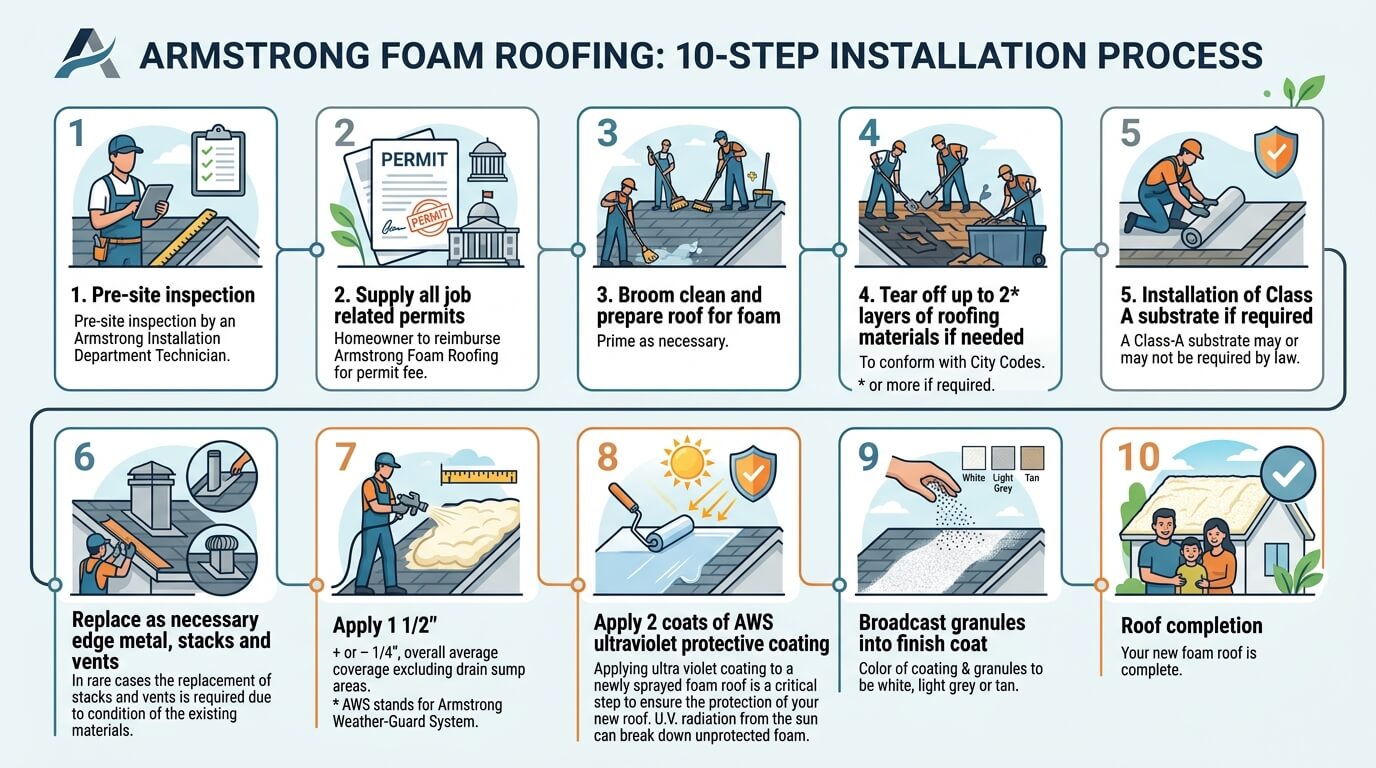
Armstrong’s detailed 10-step installation process ensures proper application under correct conditions, backed by comprehensive 15-year warranties. We also handle necessary permits and minimize overspray, ensuring a professional and compliant installation. As a family-owned business serving the Bay Area since 1966, Armstrong prioritizes customer satisfaction and stands behind its work.
Ready to Stop Overpaying for an Underperforming Roof?
Get your FREE roof evaluation from Armstrong Foam Roofing today.
Our Bay Area SPF specialists will assess your current roof, identify failure points, calculate your potential energy savings, and provide a no-obligation proposal for an Armstrong SPF system designed for your specific building.